What a crawl space hygrometer tells you, which humidity ranges EPA and Building America cite, what a federal study logged in real crawl spaces, and what a single reading cannot show.
Use an AI assistant to explore the article
Choose an assistant. The article link and a ready-to-use summary prompt will be copied automatically.
 ChatGPT
 Gemini
 Claude
 Perplexity
 Grok
Table of contents
Most advice about crawl space moisture tells you to fix something: seal the vents, cover the ground, add a dehumidifier. Almost none of it tells you how to know whether the fix worked. A hygrometer, the small meter that reports relative humidity, is the cheapest way to turn a guess into a number. But a number only helps if you know what it means, how it moves with the seasons, and where the guidance stops.
This guide explains what U.S. government and Department of Energy (DOE) building science sources say about measuring humidity in a home and in a crawl space: which ranges they cite, what a federal retrofit study actually recorded, and what the sources do not tell you. It is general information, not a diagnosis. A meter reading cannot tell you where moisture is coming from, so a high number is a reason to investigate, not a conclusion.
The Short Answer
The U.S. Environmental Protection Agency (EPA) says relative humidity can be measured with a moisture or humidity meter, and advises keeping indoor humidity below 60 percent, ideally between 30 and 50 percent. A Building America guide from Pacific Northwest National Laboratory says humidity above 50 percent will support the growth of mold and that a permanent dehumidification system may be needed to maintain 30 to 50 percent humidity in a conditioned, non-vented crawl space. A hygrometer tells you which of these ranges your crawl space is in. It does not tell you why.
- Measure first, over time, before buying equipment or hiring work.
- Treat sustained readings above about 50 percent as a prompt to look for the moisture source.
- Fix liquid water and drainage problems before relying on humidity control.
What a Hygrometer Measures
Relative humidity is the amount of water vapor in the air compared with the most the air could hold at its current temperature, shown as a percentage. That detail matters in a crawl space, because the same amount of moisture produces a higher percentage when the air is cooler. A federal retrofit report makes the point with a case in which insulating the floor instead of the walls would have left a crawl space colder, raising its relative humidity and, in the authors’ words, resulting in mold and rot in a short time. The reading is therefore a product of two things at once, moisture and temperature, and a good meter shows both.
The EPA’s homeowner guide describes the instrument simply: relative humidity can be measured with a moisture or humidity meter, a small instrument available at many hardware stores. The EPA guide does not recommend a particular type, and neither do the Building America sources used here. This guide does not rank or recommend products either.
The Ranges the Sources Cite
Three sources give numbers that are easy to confuse, because they answer slightly different questions. The table separates them.
| Source | What it says | What it applies to |
|---|---|---|
| EPA, Brief Guide to Mold, Moisture and Your Home | If possible, keep indoor humidity below 60 percent, ideally between 30 and 50 percent | Indoor humidity in a home generally, not a separate crawl space target |
| Building America, Pre-Retrofit Assessment of Crawlspaces and Basements | Humidity levels above 50 percent will support the growth of mold; a permanent dehumidification system may be needed to maintain 30 to 50 percent in a conditioned, non-vented crawl space | Crawl spaces and basements being assessed before a retrofit |
| Same Building America guide | If indoor relative humidity above 70 percent persists once the space is enclosed, supplemental dehumidification may be required | A crawl space after it has been enclosed (sealed) |
Notice that the EPA and Building America lines are not identical. The EPA number is a general ceiling for living space, with an ideal band beneath it. The Building America guide is written for crawl spaces and notes that the floor deck and all framing in the crawl space are vulnerable to some level of fungal attack if moisture levels go unchecked. If your readings sit between 50 and 60 percent, the two sources point in different directions, and the sensible reading is that you are close enough to the mold-supporting range to look for causes and watch the trend rather than ignore it.
What a Federal Study Recorded in Real Crawl Spaces
Numbers from a guide are targets. Numbers from a monitored building show how much a crawl space moves. A Building America report by Armin Rudd of Building Science Corporation evaluated crawl space retrofits in multifamily buildings and tracked their conditions for more than a year. The details are specific to those buildings, so they are an illustration, not a forecast for your house. Still, they show what a logged crawl space looks like.
- The seasonal swing was large. Relative humidity in the unvented crawl spaces ranged from about 25 percent in the winter to about 80 percent in the peak of summer.
- Rain and a switched-off fan raised it further. Some readings went above 80 percent with rain events, and in the one crawl space where the exhaust ventilation fan had been inadvertently turned off.
- Humidity tracked wood moisture. Moisture content in the joists measured at mid-span ranged from 6.3 to 9.6 percent by weight, and the report notes it was higher in the crawl spaces with higher air humidity.
- The trouble spot was where the fan was off. In that crawl space, some visibly wet joist ends were found at 40 percent moisture content. The report’s reference table lists wood at fiber saturation at 28 percent and wood in equilibrium with 85 percent relative humidity at 16 percent.
- Condensation appeared at 70 percent. One photograph in the report shows condensation on a cold structural beam at an exterior wall in a humid crawl space at 70 percent humidity, in December.
The study also shows how the researchers measured. On the day of post-retrofit testing, a temperature and humidity data logger was left in each of eight crawl spaces, recording measurements every three hours for 496 days. The point of logging was to track conditions over different seasons and rain events rather than rely on a single visit.
A Single Reading Is Not a Measurement
That study is the most useful lesson for a homeowner. A crawl space that reads 45 percent on a dry spring morning may read far higher in July or after a storm, and the reverse can happen in winter. If you only check once, you are sampling one point of a curve. A few practical habits follow from the sources, and none of them require special equipment:
- Check at different times. Look after rain and in the humid part of the year, not only on a dry day.
- Write the readings down. Note the date, the humidity and the temperature. A trend is easier to judge than a snapshot.
- Look for the visible clues too. The EPA guide says condensation or moisture collecting on surfaces can be a sign of high humidity and that you should act quickly to dry the surface and reduce the source.
- Keep a baseline. Record a reading before any change so you can compare afterward, as the researchers did before and after their retrofits.
The sources do not say where in a crawl space a sensor should sit, how close to the ground or the subfloor, or how accurate a consumer meter needs to be. Because those details are not given, this guide does not invent them. If the placement matters to a decision, ask the contractor or inspector how they measured and where.
What to Do With the Numbers
A reading is the start of a diagnosis, not the end. The Building America guide is explicit about the order: sources of moisture should be addressed, and crawl spaces and basements must have a drying mechanism. It adds that vents to the outside are meant to provide that function in a vented crawl space, although in climates with humid summers they can introduce more humidity than they remove if the outside air is more humid than the crawl space air. That is why a high reading in summer does not automatically mean opening more vents helps. Our guide to crawl space vents goes through that question.
Depending on what you find, the next step differs:
- Standing water, wet soil or a damp slab: this is a liquid water problem, and humidity control will not solve it. Start with our guide to a wet crawl space. The EPA guide notes that if wet or damp materials are dried within 24 to 48 hours after a leak or spill, in most cases mold will not grow.
- Humid air with no visible water: see our guide to moisture in a crawl space for how vapor, ground cover and ventilation interact.
- Readings stay high in an enclosed crawl space: the Building America guide says supplemental or permanent dehumidification may be needed. See our guides to dehumidifier sizing and to crawl space fans, which covers exhaust ventilation as a drying mechanism.
- A musty smell with normal readings: a meter reading does not rule out hidden growth. See musty smell from a crawl space.
Keep the limits of the evidence in mind. The EPA states that no federal limits have been set for mold or mold spores, and that in most cases where visible mold growth is present, sampling is unnecessary. A humidity reading is not a mold test, and a normal reading is not proof of a dry structure.
Questions to Ask Before Paying for Humidity Control
- What were the humidity and temperature readings, over what period, and where were they taken?
- Was the moisture source identified, and is liquid water ruled out?
- Will the work include a way to keep measuring afterward, so we can see whether it worked?
- If the crawl space will be sealed, what is the drying mechanism and who checks it?
- Has the plan been checked with the local code officials, as the Building America guide advises for conditioning a crawl space?
When to Call a Professional
- Readings stay high after you have addressed obvious sources.
- You see standing water, active leaks, or damaged or soft framing.
- There is extensive visible mold or a persistent odor.
- You are planning to seal the crawl space or add equipment.
Ask for readings and observations to be written into the scope, not only a recommendation.
FAQ
What humidity should a crawl space be?
The sources give ranges rather than a single legal number. The EPA advises keeping indoor humidity below 60 percent, ideally 30 to 50 percent. A Building America guide says humidity above 50 percent will support mold growth and cites 30 to 50 percent as the level a permanent dehumidification system may need to maintain in a conditioned, non-vented crawl space.
Does a hygrometer detect mold?
No. It measures humidity. The EPA notes that sampling is unnecessary in most cases where visible mold is present, and that no federal limits have been set for mold or mold spores.
How often should I check?
The sources do not set a schedule. A federal study used loggers that recorded every three hours for over a year. For a homeowner, checking at different seasons and after rain, and writing the results down, shows more than one reading.
Why is my crawl space humid in summer?
One reason the Building America guide gives is that in climates with humid summers, outside air can be more humid than crawl space air, so vents can bring in more moisture than they remove. Liquid water, wet soil and slabs are other causes.
Is a high reading an emergency?
It is a signal to investigate. The EPA says moisture control is the key to mold control and that quick drying after a leak prevents most growth. A reading cannot say how long a condition has lasted or whether damage exists, so look at the structure too.
Related Guides
- Moisture in a Crawl Space: vapor, ground cover and ventilation.
- Wet Crawl Space: liquid water first.
- Crawl Space Vents: open, closed or sealed.
- Crawl Space Fans: exhaust ventilation.
- Crawl Space Dehumidifier Size: sizing the equipment.
- Musty Smell From a Crawl Space: hidden growth.
Sources and Further Reading
- U.S. Environmental Protection Agency, A Brief Guide to Mold, Moisture and Your Home.
- Building America Solution Center, Pre-Retrofit Assessment of Crawlspaces and Basements.
- Armin Rudd, Building Science Corporation, for the U.S. Department of Energy Building America program, Evaluation of Crawlspace Retrofits in Multifamily Buildings (2014).
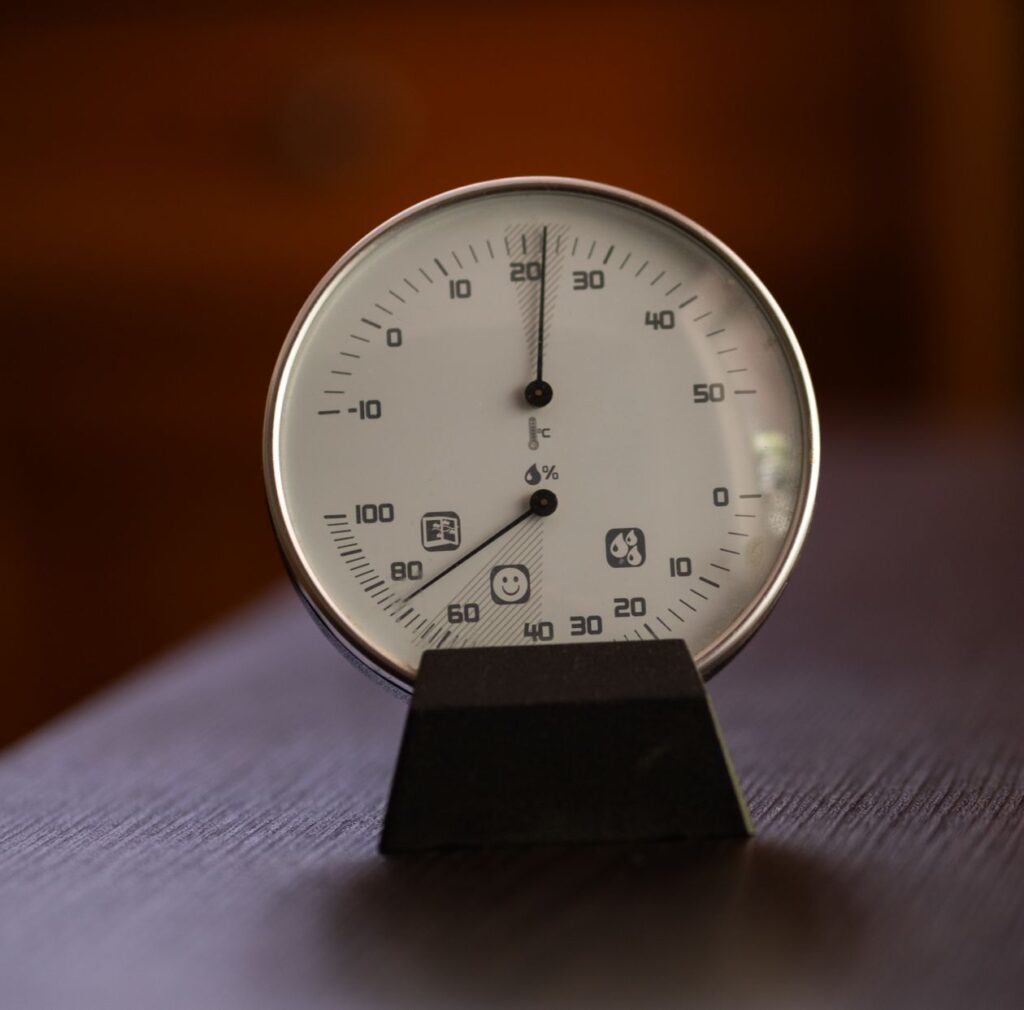
Last reviewed: November 2, 2026. General information, not a diagnosis or engineering advice. Humidity targets and code requirements vary by situation and jurisdiction. Featured image: stock photo of an analog hygrometer and thermometer by Doğan Alpaslan Demir on Pexels; representative only, not a crawl space.
This guide is educational. Structural movement, contaminated water, widespread mold, electrical hazards, or recurring flooding may require an on-site professional assessment.